From Srirangam’s Rupture to the Rise of Vijayanagara
About this post:
This is a chapter from my upcoming book — a story about rupture, transmission, and the civilizational arc that began when a god went into exile.
Before There Was an Empire, There Was a God in Exile
The island temple of Sri Ranganathaswamy at Srirangam was, in the early fourteenth century, one of South India’s great ritual centers. Pilgrims moved through its courtyards in steady cycles. Priests, scholars, artisans — entire communities whose lives ran on the temple’s rhythms.
That continuity broke under pressure from the north.
Malik Kafur’s forces swept south. The temple’s own chronicle, the Koyil Olugu, gives the event its sharpest edges: panic, the concealment of sacred icons, a massacre of devotees. The processional image of Ranganatha did not remain in Srirangam. Priests carried it away.
A god in exile.
An empty temple.
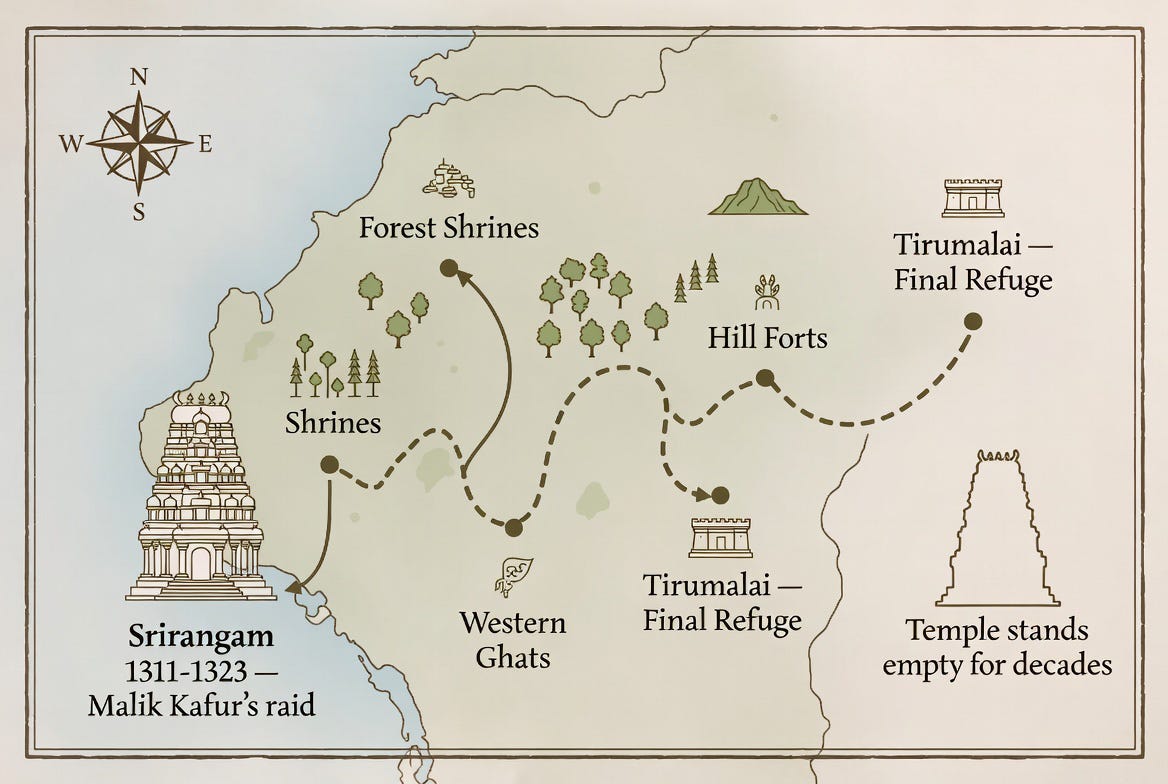
Srirangam Rupture Diagram — The God in Exile, 1311–1371
What Delhi Did to Them
The Tungabhadra in June runs slow and bronze through rock that looks older than memory. The granite hills on the south bank rise in fractured pillars — Deccan geology, indifferent and immense.
In the early 1330s, this stretch of riverbank had no name worth recording. What it had was a defensible ridge, a river crossing, and proximity to the road networks threading between what remained of the Hoysala and Kāmpili territories after the Delhi Sultanate had finished dismantling them.
Two brothers were somewhere near that ridge.
Harihara and Bukka — sons of a chieftain named Sangama — had spent the previous years accumulating experiences no man chooses.
Kāmpili fell in 1327.
They were taken north to Delhi.
Converted under pressure.
Given new names.
Sent back south as proxies.

Delhi’s Operating System Reset
The Brothers Build Amid Collapse
Surviving erasure isn’t erasure. In certain precise conditions, it is the opposite.
That survival fueled what came next.
They held ground on the Tungabhadra. They absorbed the remnants of the collapsed Hoysala and Kāmpili zones, extending patronage to the ritual networks that Delhi had ignored or disrupted.
This was not generosity.
It was a governing theory.
In South India, political power and religious legitimacy were not separate systems. They reinforced each other, or they both failed.
By the mid-fourteenth century, the regional base was becoming imperial.
Tughluq’s overextension fractured the Sultanate’s southern reach.
The opening widened.
Vijayanagara expanded.
None of this was accidental.
And none of it was complete without what the granite ridge had already provided.
The Meeting on the South Bank
The tradition does not record the exact year of their encounter with the ascetic who changed everything. What it preserves is the shape of the meeting.
A man sitting with his back against the granite.
Watching the river.
Not strategizing.
Not praying.
Just existing in the exhaustion that settles when you stop pretending you understand your own life.
He occupies an interval.
The man he was is gone.
The man he might become has no shape yet.
Something had been waiting.
Into that ripeness walked Mādhava — whom history would know as Swami Vidyāraṇya.
A philosopher.
A realized teacher.
A man who saw past the roles the brothers had been forced to wear.
What he gave them was dīkṣā — initiation as recovery and restoration of their deeper identity.
The Rational Objection
The analytically trained reader will raise a hand.
What explains Vijayanagara’s rise is a confluence of geopolitical conditions: Tughluq’s overextension, the collapse of Hoysala and Kakatiya power, the resulting vacuum, and the brothers’ administrative competence.
All true.
But structural analysis explains the context without explaining the choice.
The fourteenth-century Deccan was full of capable administrators navigating a power vacuum. Almost none of them founded anything that outlasted their own lifetimes.
The gap between “conditions are favorable” and “we will act, now, at this scale, with this total commitment of self” is not closed by structure.
Something in the human system has to close it.
The tradition names that something śraddhā — the settled conviction beneath deliberation. It is not optimism, not willpower, not belief. It is the condition in which the question of whether to proceed has already been answered.
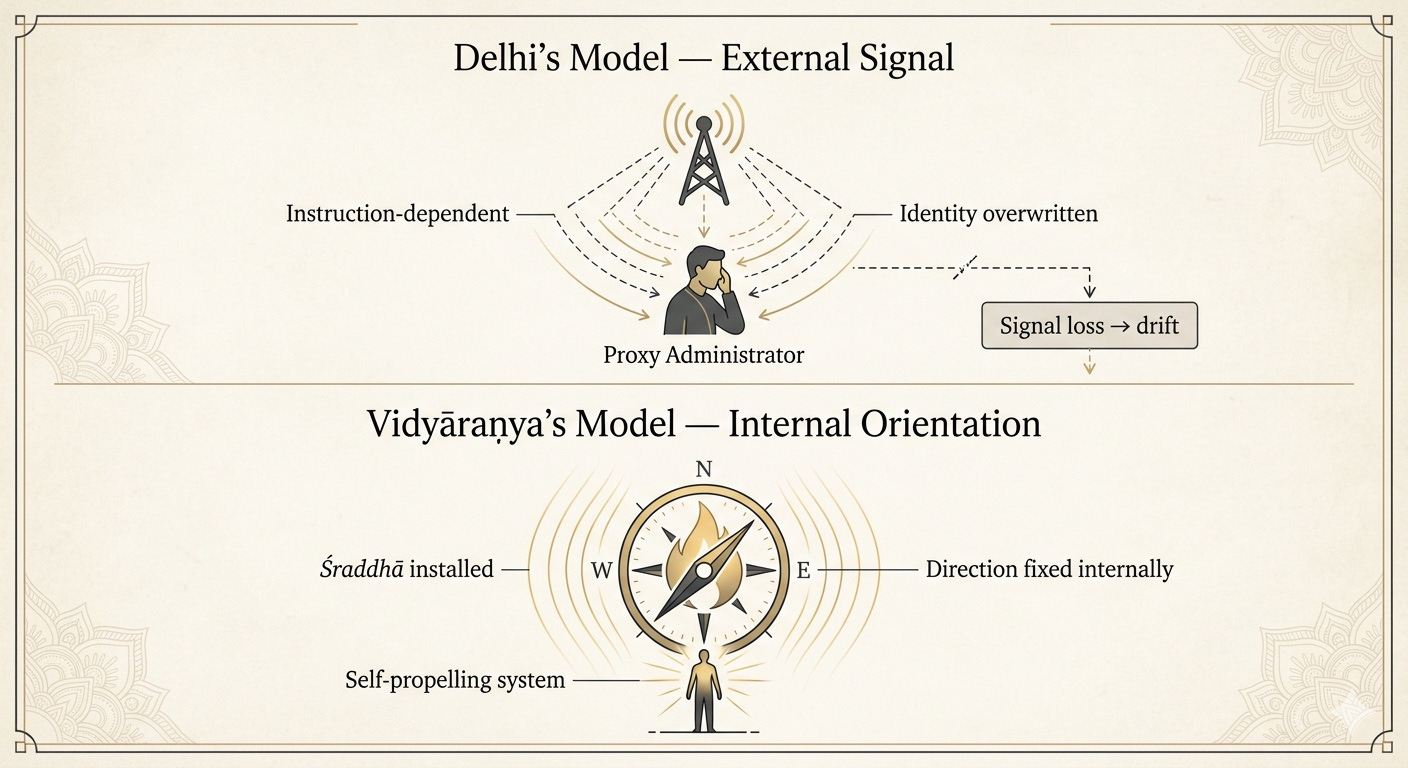
External Signal vs Internal Orientation — Delhi’s Model vs Vidyāraṇya’s Model
The Charge That Did Not Expire
Grace by subscription fades.
Grace by transmission compounds.
Vidyāraṇya did not give them a better plan.
He gave them orientation — an internal navigation system. A direction that did not require renewal.
Harihara died in 1356.
Bukka ruled until 1377.
The empire kept generating.
Transmission outlasts the transmitter.

Why the Charge Didn’t Expire — Subscription Model vs Endowment Model
Stone Evidence
The strongest evidence for the early Vijayanagara period comes from stone.
Sringeri records show Sangama ties from 1346 onward.
A 1356 inscription records a donation by Bukka I.
A 1375 inscription names Vidyāraṇya as a recipient of royal endowment.
The relationship was not a one-time blessing.
It was an alliance that deepened across decades.
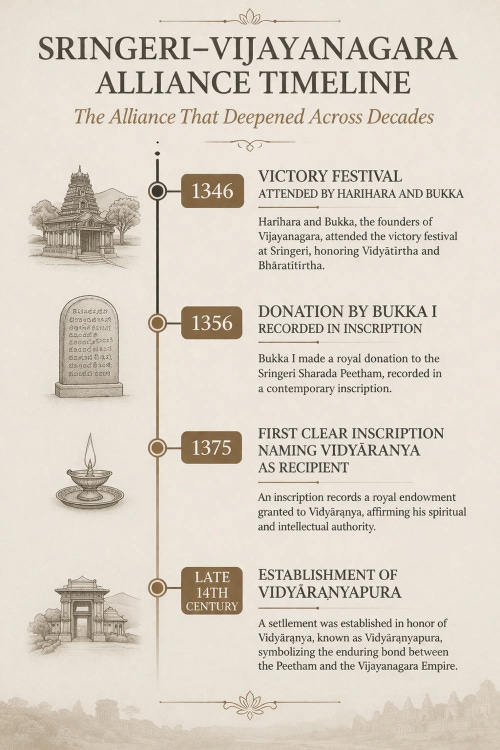
Sringeri–Vijayanagara Alliance Timeline — The Alliance That Deepened Across Decades
The God Comes Home
The arc that began with Srirangam’s rupture closes in a remarkable inscription.
Dated 1371–72 CE, it credits the general Gopana with retrieving the deity from Tirumalai, performing worship along the route, defeating occupying forces, and reinstalling the processional image at Srirangam.
The god that had been carried away in panic came home.
This was not incidental.
It was the empire proving what it understood itself to be: dharmic continuity restored where it had been broken. Southern culture protected where it had been exposed.
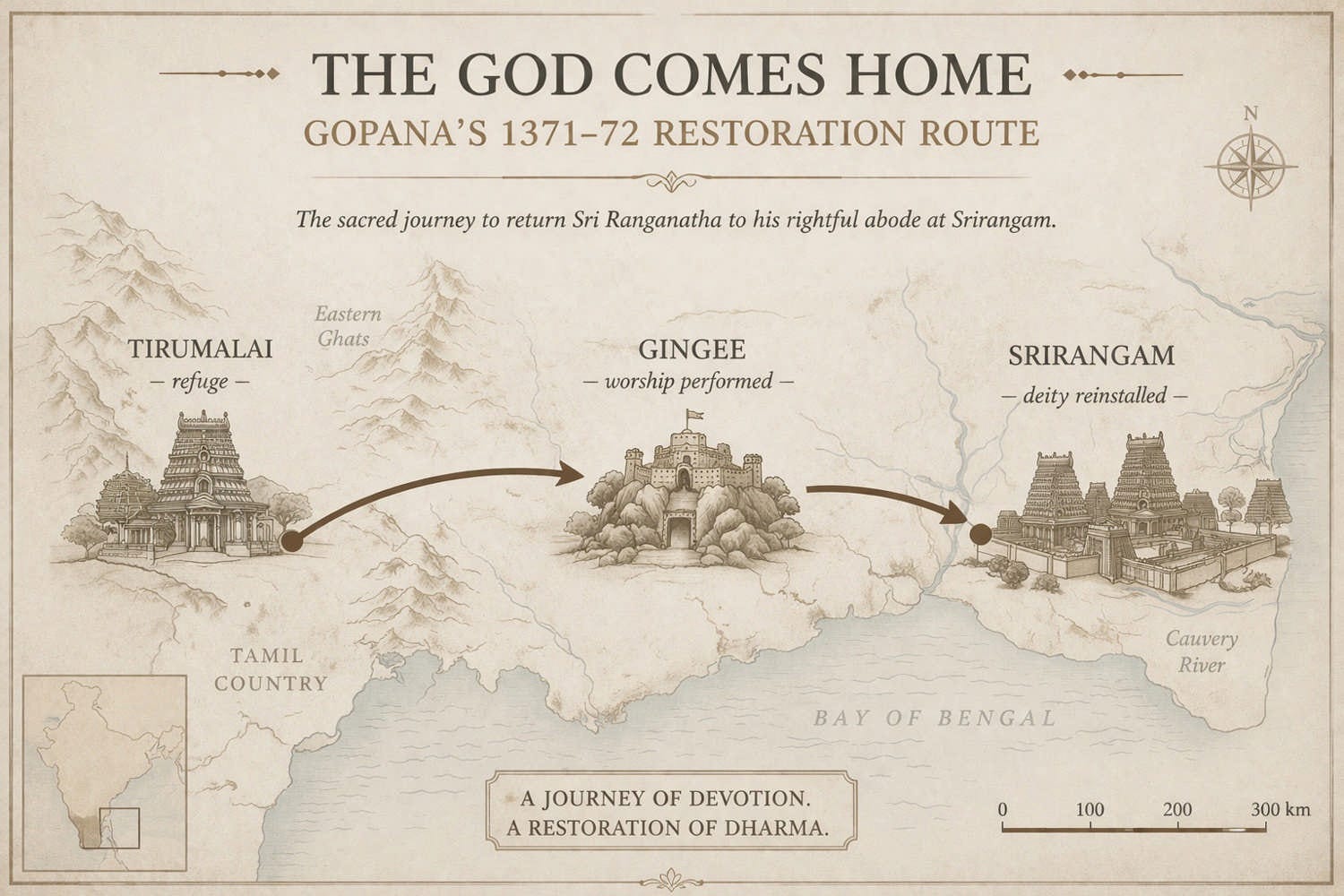
The God Comes Home — Gopana’s 1371–72 Restoration Route
What Compounded
At its height under Kṛṣṇadeva Rāya, Vijayanagara was among the largest cities in the world. Domingo Paes described markets stocked with goods from every corner of the known world.
Kṛṣṇadeva Rāya never met Vidyāraṇya. Nearly a century and a half separated them.
Yet the civilizational framework within which he ruled — the understanding of Vijayanagara as the guardian of dharmic culture in the south — was recognizably continuous with the conviction transmitted on that granite ridge.
The charge had not expired.
It had compounded.
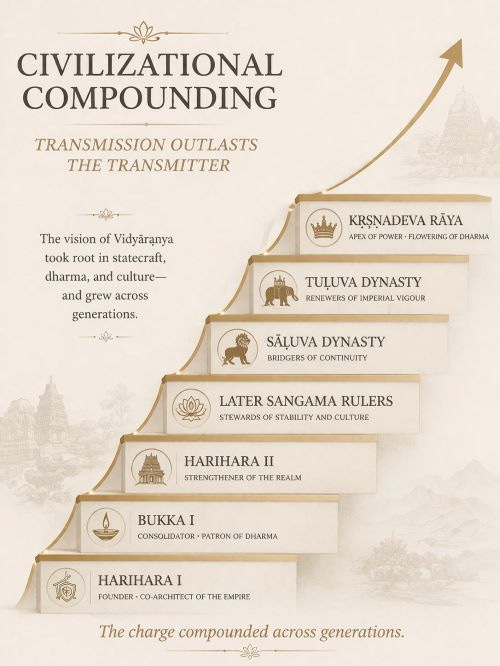
Civilizational Compounding — The Charge That Outlasted the Transmitter
The Question for the Reader
The priests who carried Ranganatha out of Srirangam did not know when they would bring him back. They knew only that abandoning what they were charged to carry was not an option.
The Sangama brothers did not seek Vidyāraṇya from a position of strength. They arrived emptied — of titles, of identity, of the self-understanding that had organized their lives.
The captivity that appeared to have destroyed them had removed the one obstacle that prevents genuine transmission from taking hold: the assumption that you already know who you are.
The Vijayanagara story is not a template for empire-building.
It is evidence that a single authentic transmission, received at the right moment, can install a directional conviction no amount of self-generated effort can replicate.
The charge lasted two hundred years.
It brought a god home from exile.
It held a civilization together.
The lineage that carried it is still operative.
Somewhere in the Karnataka hills, the chant still rises:
Karṇāṭaka Siṃhāsana Pratiṣṭhāpanācārya.
He Who Established the Karnataka Throne.
Seven centuries later, the title still holds.
The grid is still connected.
What would it mean to arrive with nothing left to protect.
If you enjoyed this chapter…
You can subscribe for:
- new chapters
- behind-the-scenes notes
- diagrams + visual companions
- reflections on dharma, identity, and attention
Thank you for reading.


No comments:
Post a Comment