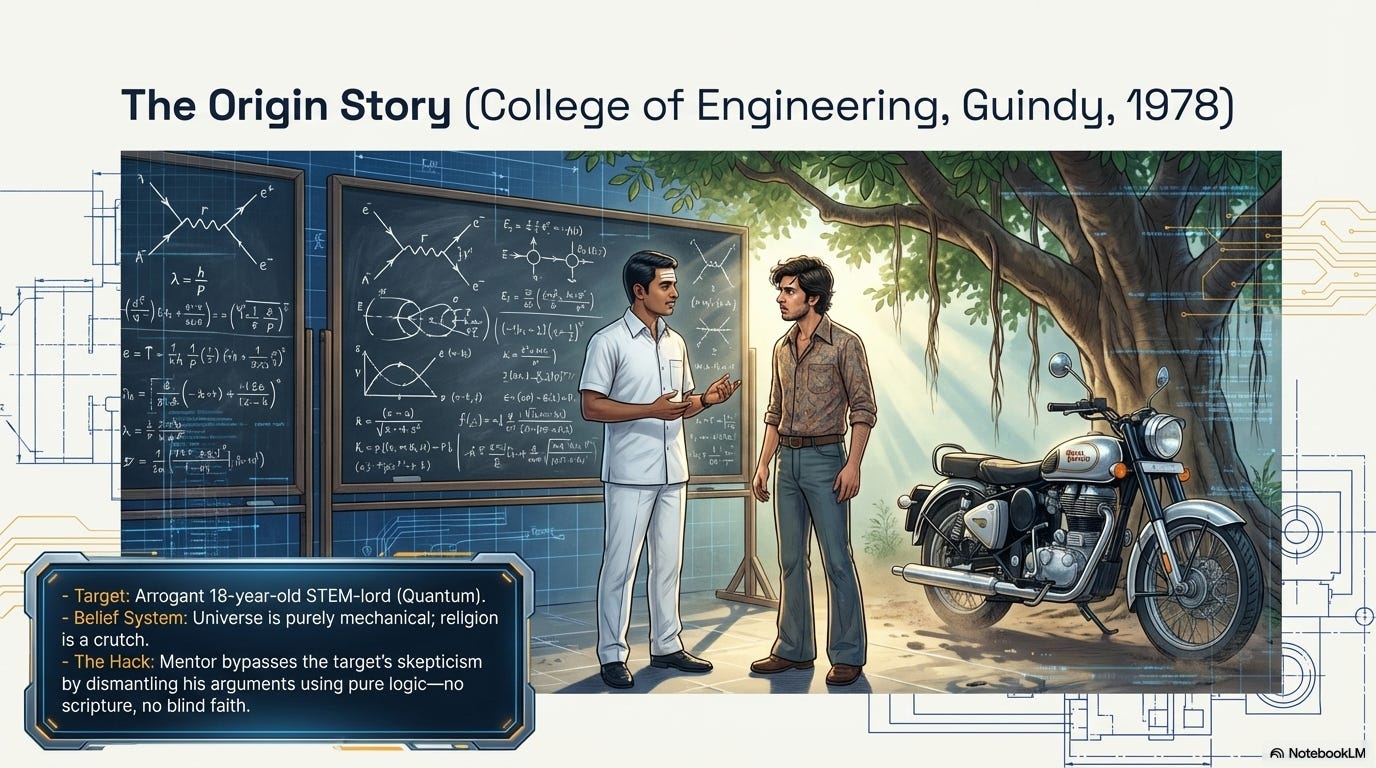
Circa 1979. KK Nagar, Chennai.
The bottom flat of a three-story MIG block on PT Rajan Road. Home of SV — my junior from Guindy Engineering College. A crowd has assembled for the Satsang. Then a Royal Enfield rolls in, and all the chatter and light banter subsides to a hush.
Sri RMU — my mentor — settles in to start the pooja.
Everyone goes quiet. All eyes on him. Satsangs those days started with a Bhajan, followed by Sri RMU's puja, then social mixing and a sumptuous dinner
Those were different times. My cousins and I would walk from our house in 12th Avenue, Ashok Nagar, 10th Avenue, then to PT Rajan Road, spread across the full breadth of the road. No fear of traffic. It was that light. You could get on the 12B bus at the Ashok pillar stop and find a seat without any difficulty.
But that’s not the story.
The story is what happened when the abhishekam found its rhythm.
Sri RMU is completely absorbed. Then — you notice it. His lips are moving. Not chanting. Something else. He speaks. He pauses. He listens. He smiles. There is an unmistakable quality of affection in his face — the intimacy of an actual exchange.
He is conversing with the deity being worshipped.
Everyone watches. No one knows what to say. What everyone noticed was a room was surcharged with deep Spiritual vibes.
To anyone unfamiliar with what was happening, it might look like a hallucination. A person talking to a Goddess in a picture frame. No one there. No one replying.
Hold that thought.
Circa 800 CE. Adi Shankara. Brahmasutra Bhāshya 1.3.33.
The sutra being examined: are gods eligible for brahmajnana? Shankara says yes. But it’s what comes next in the bhashya that matters.
He states that the ancient rishis directly perceived the gods. Not symbolically. Not metaphorically. Pratyaksha — direct perception, the same category of knowing as seeing a mango in your hand.
The objection is immediate: no one today sees gods. How can you claim this was real?
Shankara’s reply is surgical. What is impossible now, he says, could have been possible then. The world changes. Capacities change. But the mechanism itself has not been destroyed — it has been described and preserved. He cites Yoga Sutra 2.44: svādhyāyād iṣṭa-devatā samprayogaḥ — from sustained self-study and practice comes communion with the chosen deity. He backs it with Shvetashvatara Upanishad 2.14, where the Veda itself praises the yogic path.
His point: the rishis revealed the Vedas because they had developed, through yogic practice, the capacity to commune directly with deities. The capacity is not fiction. It is documented. It has a mechanism. And that mechanism cannot be dismissed simply because most people are not doing the work required to access it.
Twelve hundred years of intellectual history, and the objection has not changed. Neither has the answer.
1982. Pravachana Mandiram, Mandaveli, Chennai.
A large gathering of devotees. Waiting. The hall filled with that particular quality of anticipation that only comes when you know what is about to be given is rare.
Our Acharyal rose to deliver the Anugraha Bhashanam — the Gracious Address, words of grace and benediction offered to the assembly.
The title: Dhyanam.
What followed was not instruction in the ordinary sense. It was a revelation, offered with the authority of one describing territory already traversed. Beginning with the full arc of meditation practice, Acharyal drew the assembly into a specific and extraordinary domain: Saguna Dhyanam — meditation on the Lord with form.
Stage by stage. And as each stage unfolded, the wonder in the hall deepened.
First, the object. Take a specific form of the Divine as your focus. Acharyal gave the Kaivalya Upanishad example: meditate on Parameshwara as Umāsahāyaṃ, the consort of Uma. Not a generic idea of the Divine. A specific, beloved form — held with precision, held with love, held without wavering.
Second, the practice. Close your eyes. Continuously, without interruption, fix the mind on that form. Sustained, loving, unbroken focus leads to Samprajnata Samadhi — deep absorption, still aware of the distinction between self and Divine, but the ordinary agitation of the mind stilled entirely.
Third — and here the assembly leaned in — the manifestation. Persist, Acharyal said. If you truly persist, the exact deity being meditated upon will take form before you. Will come. Will be present.
Fourth — the one that should stop every sceptic cold.
Even if the practitioner opens their eyes.
Read that again. The practitioner opens their eyes — returns to the ordinary waking world, the room, the walls, the light of day — and the deity continues to be beheld. In resplendent form. Luminous. Present. Undiminished.
The vision is not a product of closed eyes and a quieted mind. It does not dissolve when the eyes open. It was never inside the head to begin with.
This is Devata Sakshatkara. The Divine, standing before you. As real and immediate as this page before you now.
Fifth, the Divine Word. In that state, any question or doubt that arises receives a direct answer from the deity. Not interpretation. Not inference. A command. A response. Received directly. Deiva Vaak — the very voice of the Divine, speaking to the one who has arrived.
Sixth — uddharana shakti. The power that flows from this state is not merely personal liberation. The practitioner becomes the bridge by which others cross. To lift. To redeem. To raise. Not just to reach the other shore, but to become the vessel that carries others to it.
Acharyal was not speaking of a distant possibility. He was describing a living process — with stages, with conditions, with outcomes — to a hall full of devotees who had come precisely because they sensed that what was being described was real.
It was.
2013. Sacramento.
Running late. Swerving around a plastic bucket on the freeway. Desperately trying to make the final session of a spiritual discourse being led by a teacher I’d known years earlier — fresh out of engineering college, working in the Sacramento area, no different then from anyone else in our circle.
Now an Acharya. Hundreds of students. A prominent Vedanta institution.
After the class, he pulls me aside.
“Do you remember the book you gave me?”
Complete blank. I say no. Then vaguely — yes, maybe, something, years ago.
“Yoga, Enlightenment and Perfection. I took it with me to my training in India. I carried it everywhere. That book is the railway track I run my spiritual life on. Whenever I deviate from the track, I come back to it. It totally transformed my life.”
“I want to meet your Guru. Even if I have to fly to India to meet Him, I am willing to do it.”
The book was written by Sri RMU. My mentor. The one who had, on a Sunday evening in KK Nagar, been having a conversation with a deity.
I had given this teacher the book without a second thought and then forgotten the act entirely. No plan. No intention. No memory of it.
And yet — an Acharya. A railway track. Hundreds of lives shaped by a teacher whose own path was shaped by a book passed without ceremony, in a gesture so small it left no trace in me.
Go back to KK Nagar.
Go back to that pooja room, that Sunday at 6 PM, that room that went still without anyone asking it to. Go back to the lips moving, the pause, the smile, the unmistakable quality of a conversation being held with someone who was listening.
What Shankara defended in 800 CE as philosophically coherent, what Acharyal laid out in 1982 at Prachchanai Mandiram as a living process with exact stages and verifiable outcomes — you just watched it. In a bottom flat in KK Nagar. In Chennai. In 1979.
Would you call it hallucination now?
Because uddharana shakti — the power to become the bridge by which others cross — had already been set in motion that evening, in that room. It moved, without announcement, through a forgotten book, across continents and decades, into an Acharya and his hundreds of students.
No one writes about it.
Every morning, in millions of homes across this country, people do their pooja, mark their foreheads with vibhuti or kumkum, offer flowers, and go on with their day. The deity does not speak. The form does not appear.
But what we witnessed in that bottom flat on PT Rajan Road is worthy of being shouted from the rooftop of that three-story MIG flat.
Someone must write about it.
I am. Here. And in a book.
Tesla = Dhyāna: Self-Driving to the Self — forthcoming from Morgan James Publishing.
TheSelfDrivingMind.com
Sources: 1. Puja :Eyewitness account colloborated with SV. 2. Sankara reference (Advaita-L posts on Yoga vs Advaita). 3. 1982 Dhyanam speech (Center for Brahma Vidya). . 2013 - A book that transformed.. (Blogger Post)